Oligoscan is an innovative medical device
Physiological imbalance screening. Non-invasive, no blood test needed.
Learn moreOligoscan easy to use
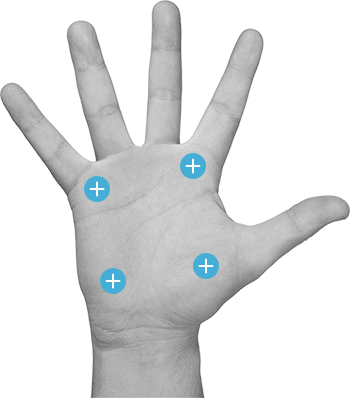
A quick evaluation of minerals and toxic metals in the palm of the hand.
Learn moreScreening of physiological imbalances helps better health control and trace minerals overall wellbeing.
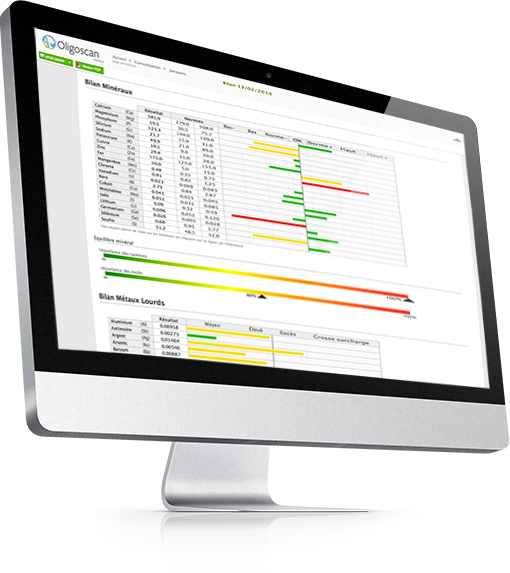
Excess and deficiency in minerals
A risk of toxic metals poisoning
Responsible for aging and numerous other diseases
Instant measurements of minerals, trace elements, oxidative stress and toxic metals.
Oligoscan can be used by all health specialists allowing for rapid and pain free analysis.
The measurement is taken directly by a portable spectrometer connected to a computer
The technology is based on spectroscopy
Evaluation of trace minerals reserves, the level of oxidative stress and toxic metals
Non-invasive measurement taken in situ
The record provided allows for detection of trace elements and minerals deficiencies as well as high rate of toxic metals in the body.
Oligoscan is now used by health professionals in many countries as a solution whenever a quick and accurate analysis of the level of trace elements, minerals and toxic metals is needed.
The Oligoscan uses optical technology : spectrophotometry.
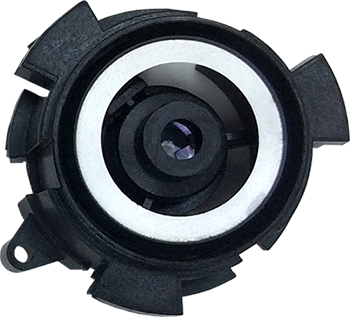
This is a quantitative analytical method of measuring the absorption or the optical density of a chemical.
It is based on the principle of absorption, transmission or reflection of light by the chemical compounds over a certain wavelength range.
Spectrophotometry is used in many areas : chemicals, pharmaceuticals, environment, food, biology, medical / clinical, industrial and others.
In the medical field, spectrophotometry is used to examine blood or tissue.
The Oligoscan is a reliable and scientifically proven tool..
A set of tests and comparative studies have been made by researchers highlighting a correlation between the results of the Oligoscan and those performed in the laboratory.
Today, this "German nylon" aesthetic is often explored through: Retro Editorial Photography
Germany has a rich history of textile production, dating back to the Industrial Revolution. Over the years, German manufacturers have consistently pushed the boundaries of innovation, developing new materials and technologies that cater to various industries. Nylon, a synthetic polymer, has been a significant part of this story.
While "German nylon pics" often appears as a search term for hosiery enthusiasts or in vintage photography forums, the history of nylon in Germany and its visual documentation is a fascinating intersection of industrial innovation and fashion history. The Synthesis of a Revolution
In this article, we'll take a photographic journey to explore the world of German nylon products, highlighting their features, benefits, and various uses. Whether you're an outdoor enthusiast, a photographer, or simply someone interested in high-quality materials, this article aims to provide you with a deeper appreciation for German nylon products.
: You can still find authentic vintage-style stockings made on traditional machines in Germany, preserving the craftsmanship of the 1950s.
: Provides a significant archive of both contemporary and historic high-resolution photography featuring various styles of nylon hosiery.
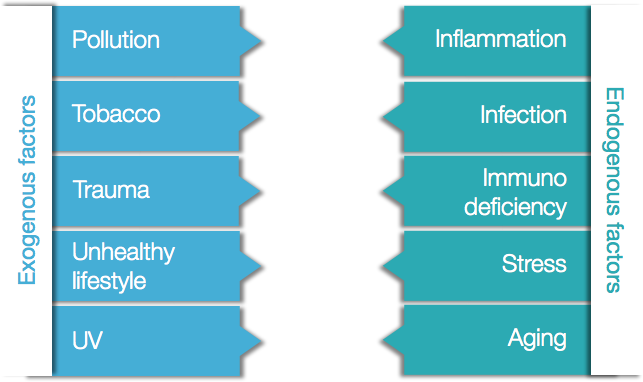
Free radicals are molecules produced in small amounts by the body. These free radicals are very reactive substances, capable of damaging the components of the cells (enzyme proteins, lipid membranes, DNA).
Their production is particularly stimulated by the exposure to sunlight (UV), tobacco, pollution, pesticides, etc.
A diet rich in antioxidants, particularly found in some fruits and vegetables, is essential in fighting free radicals.
Some scientific references :
Today, this "German nylon" aesthetic is often explored through: Retro Editorial Photography
Germany has a rich history of textile production, dating back to the Industrial Revolution. Over the years, German manufacturers have consistently pushed the boundaries of innovation, developing new materials and technologies that cater to various industries. Nylon, a synthetic polymer, has been a significant part of this story.
While "German nylon pics" often appears as a search term for hosiery enthusiasts or in vintage photography forums, the history of nylon in Germany and its visual documentation is a fascinating intersection of industrial innovation and fashion history. The Synthesis of a Revolution
In this article, we'll take a photographic journey to explore the world of German nylon products, highlighting their features, benefits, and various uses. Whether you're an outdoor enthusiast, a photographer, or simply someone interested in high-quality materials, this article aims to provide you with a deeper appreciation for German nylon products.
: You can still find authentic vintage-style stockings made on traditional machines in Germany, preserving the craftsmanship of the 1950s.
: Provides a significant archive of both contemporary and historic high-resolution photography featuring various styles of nylon hosiery.